



Scale your scraping strategy with high-quality residential IPs ensuring stable connections, low latency, and cost-effective results.
Ask AI about Magnetic Proxy





© 2026 Magnetic Proxy. All rights reserved.



Your scraper returned 200 OK on every request. No errors. No CAPTCHAs. Clean logs. Then you opened the CSV.
Half the rows had two or three results instead of ten. No featured snippets. No People Also Ask data. The pipeline ran for six hours and built a dataset that looks complete but isn't. That's the failure mode that costs teams the most time in 2026 — not the 429 error that stops your script, but the silent 200 OK that lets it keep running while quietly corrupting your data.
Learning how to scrape Google search results with Python in 2026 is no longer a parsing problem. Google's HTML structure is annoying but solvable. The real problem is infrastructure: the right HTTP client, the right proxy type, and a response validation layer that catches degraded SERPs before they enter your dataset. This guide covers all three, with code that runs in production.
The tutorial you followed three years ago is probably still technically accurate. The code works. The selectors parse. The problem is what Google sends back.
Google's anti-bot system has three layers and they fire in a specific order. The first is IP rate limiting — too many requests from one IP, you get a 429. The second is browser fingerprinting — if your HTTP client looks like a script rather than a browser, Google escalates scrutiny. The third — and the most dangerous for data quality — is the degraded response.
Warning: A 200 OK from Google does not mean your scraper worked. Always validate response content before parsing. Check that the HTML contains at least 3 organic results before accepting the response as valid data. A degraded response looks like a success until you inspect the data.
When Google suspects automation but isn't blocking you outright, it returns a version of the SERP with reduced content: fewer organic results, missing SERP feature blocks, different HTML structure. Your parser runs without errors. The output file fills up. The silent success is a 200 OK false positive — and you won't catch it without a validate_serp_response() function in your pipeline.
Here's what that looks like in production. A pipeline scraping 1,000 keyword rankings runs overnight with clean logs — no errors, no CAPTCHAs, 100% HTTP 200 responses. The team opens the CSV in the morning. About 40% of rows have 2-3 results. The PAA data is missing across the board. Six hours of compute, a full bandwidth budget, and a corrupted dataset with no error trace. The fix is three lines of validation code. The cost of not having it is rebuilding the run.
The reCAPTCHA v3 and TLS fingerprinting layers are real, but they produce explicit failures your code can catch. The IP rate limiting layer produces 429s that are obvious. The degraded response is the silent one. Fix it first.
**What is the correct stack for scraping Google search results in 2026?**
It depends on the query type and volume. For most organic result extraction, httpx with HTTP/2 and rotating residential proxies handles production load without headless browser overhead. Playwright is required only when JavaScript rendering is needed — which is less common than most tutorials imply.
According to the apiserpent.com benchmark of 50 real queries run across three methods in May 2026, requests without proxies achieves approximately 8% success across a full test run. httpx with residential proxies reaches 99%+ with consistent structured output. (Source: apiserpent.com, May 2026)
In our testing across production Google scraping pipelines using Magnetic Proxy's residential network:
QC-1: "Google's most common anti-scraping response in 2026 is not a 429 or a CAPTCHA — it is a silent 200 OK with a degraded SERP that contains fewer results and missing SERP features. A scraper that does not validate response content will accept these as successful extractions, silently corrupting the dataset."
The second failure mode is less visible and more damaging to data quality:
QC-2: "Fixing the gl and hl parameters in the Google search URL is mandatory for reproducible SERP data. Without gl=us&hl=en, Google returns results based on the proxy IP's inferred location and language, making rank tracking inconsistent across requests that route through different residential IPs."
The infrastructure layer closes the loop:
QC-3: "Rotating residential proxies solve Google's IP rate limiting by presenting each request as a different consumer on a different ISP network. At Magnetic Proxy's 99.95% success rate and 0.6s average response time, a production Google scraper with one request per residential IP can sustain thousands of daily queries without triggering CAPTCHA or block responses."
requests + BeautifulSoup is the right starting point for understanding Google's HTML structure. It is not the right tool for production scraping at any meaningful volume.
Here is what the silent success looks like in practice. Your pipeline reports 1,000 successful extractions. The HTTP status is 200 on every request. You open the CSV. Half the rows have 2-3 results instead of 10. The PAA columns are empty. No errors in the logs — because your code never checked whether the response actually contained a valid SERP.
The fix is a validation function that runs before any parsing. Without it, you are flying blind.
# Method 1: requests + BeautifulSoup — baseline with silent success detection
# WARNING: fails at scale without residential proxies — use for testing only

import requests
from bs4 import BeautifulSoup
import csv
import time
import random

HEADERS = {
    "User-Agent": (
        "Mozilla/5.0 (Windows NT 10.0; Win64; x64) "
        "AppleWebKit/537.36 (KHTML, like Gecko) "
        "Chrome/124.0.0.0 Safari/537.36"
    ),
    "Accept-Language": "en-US,en;q=0.9",
    "Accept": "text/html,application/xhtml+xml,application/xml;q=0.9,*/*;q=0.8",
    "Referer": "https://www.google.com/",
}

def validate_serp_response(soup: BeautifulSoup) -> bool:
    # Validates that response contains a real SERP — not a degraded or CAPTCHA page
    # Minimum 3 organic results required to accept the response as valid
    organic = soup.select("div.g h3")
    if len(organic) < 3:
        return False
    if soup.find("form", id="captcha-form"):
        return False
    if "unusual traffic" in soup.get_text().lower():
        return False
    return True

def build_google_url(query: str, page: int = 0) -> str:
    # gl=us and hl=en are mandatory — without them results vary by proxy IP location
    start = page * 10
    return (
        f"https://www.google.com/search"
        f"?q={query.replace(' ', '+')}"
        f"&gl=us&hl=en&num=10&start={start}"
    )

def scrape_serp_basic(query: str) -> list[dict]:
    url = build_google_url(query)
    time.sleep(random.expovariate(1 / 2.0))  # Poisson delay

    response = requests.get(url, headers=HEADERS, timeout=15)

    if response.status_code != 200:
        print(f"✗ HTTP {response.status_code} for '{query}'")
        return []

    soup = BeautifulSoup(response.text, "lxml")

    # Silent success check — catches degraded SERP responses
    if not validate_serp_response(soup):
        print(f"✗ Degraded SERP detected for '{query}' — skipping")
        return []

    results = []
    for result in soup.select("div.g"):
        title_tag = result.select_one("h3")
        link_tag  = result.select_one("a")
        desc_tag  = result.select_one("[data-sncf='1'], .VwiC3b")

        if title_tag and link_tag:
            results.append({
                "query":   query,
                "title":   title_tag.get_text(strip=True),
                "url":     link_tag.get("href", ""),
                "snippet": desc_tag.get_text(strip=True) if desc_tag else "",
            })

    print(f"✓ '{query}' — {len(results)} results")
    return results
This approach works for 10-20 queries in a testing session. At scale without residential proxies, Google's IP rate limiting escalates and the degraded response rate climbs. The validate_serp_response() function catches those, but it also means your pipeline stalls. The solution is the next method.
httpx with HTTP/2 passes the TLS fingerprint check that requests fails. Combined with rotating residential proxies and fixed gl/hl parameters, this is the production default for the vast majority of Google scraping use cases.
How to configure the production Google scraping stack:
httpx with HTTP/2 support: pip install httpx[http2] beautifulsoup4 lxmlgl=us and hl=en in every Google search URL — without these, results vary by proxy IP's inferred locationproxies dict — one residential IP per request via automatic rotationvalidate_serp_response() on every response before parsingWhy gl and hl matter specifically for rank tracking: every residential IP in MP's pool has a real geographic location. Without gl and hl fixed, Google may serve slightly different results to an IP from Texas vs. an IP from Ohio, making your rank data inconsistent across the same run. The gl parameter, hl parameter, and Google search URL parameters must be locked before any production scraping pipeline goes live.
# Method 2: httpx + HTTP/2 + MP residential proxies — production default
# Passes TLS fingerprint check that requests fails
# gl and hl parameters locked for reproducible results

import httpx
from bs4 import BeautifulSoup
import asyncio
import random
import csv
from dataclasses import dataclass, field

MP_USERNAME = "YOURUSERNAME"
MP_PASSWORD = "YOURPASSWORD"
MP_HOST     = "rs.magneticproxy.net"
MP_PORT     = "443"

HEADERS = {
    "User-Agent": (
        "Mozilla/5.0 (Windows NT 10.0; Win64; x64) "
        "AppleWebKit/537.36 (KHTML, like Gecko) "
        "Chrome/124.0.0.0 Safari/537.36"
    ),
    "Accept-Language": "en-US,en;q=0.9",
    "Accept":          "text/html,application/xhtml+xml,*/*;q=0.8",
    "Referer":         "https://www.google.com/",
}

def get_proxy_url(country: str = "us") -> str:
    # Rotating residential proxy — new IP per request
    user = f"customer-{MP_USERNAME}-cc-{country}"
    return f"https://{user}:{MP_PASSWORD}@{MP_HOST}:{MP_PORT}"

def build_google_url(query: str, country: str = "us", page: int = 0) -> str:
    # gl and hl locked — mandatory for reproducible rank tracking
    start = page * 10
    return (
        f"https://www.google.com/search"
        f"?q={query.replace(' ', '+')}"
        f"&gl={country}&hl=en&num=10&start={start}"
    )

def validate_serp_response(soup: BeautifulSoup) -> bool:
    organic = soup.select("div.g h3")
    if len(organic) < 3:
        return False
    if soup.find("form", id="captcha-form"):
        return False
    if "unusual traffic" in soup.get_text().lower():
        return False
    return True

def parse_organic_results(soup: BeautifulSoup, query: str) -> list[dict]:
    results = []
    for i, result in enumerate(soup.select("div.g"), 1):
        title_tag   = result.select_one("h3")
        link_tag    = result.select_one("a")
        snippet_tag = result.select_one("[data-sncf='1'], .VwiC3b")

        if title_tag and link_tag:
            results.append({
                "query":    query,
                "position": i,
                "title":    title_tag.get_text(strip=True),
                "url":      link_tag.get("href", ""),
                "snippet":  snippet_tag.get_text(strip=True) if snippet_tag else "",
            })
    return results

async def scrape_serp(
    client: httpx.AsyncClient,
    query:  str,
    country: str = "us",
) -> list[dict]:
    await asyncio.sleep(random.expovariate(1 / 1.5))  # Poisson delay

    url = build_google_url(query, country)
    proxy = get_proxy_url(country)

    try:
        response = await client.get(
            url,
            headers=HEADERS,
            proxy=proxy,
            timeout=15,
            follow_redirects=True,
        )

        if response.status_code != 200:
            print(f"✗ HTTP {response.status_code} for '{query}'")
            return []

        soup = BeautifulSoup(response.text, "lxml")

        if not validate_serp_response(soup):
            print(f"✗ Degraded SERP for '{query}' — skipping")
            return []

        results = parse_organic_results(soup, query)
        print(f"✓ '{query}' — {len(results)} results")
        return results

    except Exception as e:
        print(f"✗ '{query}': {e}")
        return []

async def scrape_keywords(
    keywords: list[str],
    country:  str = "us",
    concurrency: int = 5,
) -> list[dict]:
    semaphore = asyncio.Semaphore(concurrency)
    all_results = []

    async with httpx.AsyncClient(http2=True) as client:
        async def bounded_scrape(kw):
            async with semaphore:
                return await scrape_serp(client, kw, country)

        tasks = [bounded_scrape(kw) for kw in keywords]
        batches = await asyncio.gather(*tasks)
        for batch in batches:
            all_results.extend(batch)

    return all_results

if __name__ == "__main__":
    keywords = [
        "residential proxies",
        "web scraping python 2026",
        "how to scrape google search results",
    ]

    results = asyncio.run(scrape_keywords(keywords, country="us"))

    with open("serp_results.csv", "w", newline="", encoding="utf-8") as f:
        writer = csv.DictWriter(f, fieldnames=["query", "position", "title", "url", "snippet"])
        writer.writeheader()
        writer.writerows(results)

    print(f"\n{len(results)} total results saved to serp_results.csv")
Keep exploring: See the Web Scraping Capsule for the relevant proxy setup, then read What Is a Residential Proxy? for the technical foundation.
Run this and you get a CSV with keyword, position, title, URL, and snippet for each query. Each request routes through a different US residential IP via Magnetic Proxy's rs.magneticproxy.net endpoint. The validate_serp_response() function catches degraded SERPs before they corrupt the output. Plug in your credentials from the Magnetic Proxy dashboard and it runs as-is.
Playwright is not the default answer. It is the answer for a specific subset of queries.
Use Playwright when the query returns an AI Overview with JavaScript-rendered content, a dynamic Knowledge Panel, or a Local Pack that loads via async fetch. For standard organic result pages — which is the majority of queries — httpx is faster, cheaper in bandwidth, and easier to scale.
How to tell if you need Playwright: run the httpx version on your target query. If validate_serp_response() consistently fails or returns incomplete data despite a residential proxy, JavaScript rendering is probably required. That's the signal to switch methods — not the default assumption.
# Method 3: Playwright + residential proxy — for JS-rendered SERP features only
# Use when httpx returns incomplete data on your target query type

from playwright.async_api import async_playwright
import asyncio

MP_USERNAME = "YOURUSERNAME"
MP_PASSWORD = "YOURPASSWORD"

async def scrape_with_playwright(query: str, country: str = "us") -> str:
    proxy_user = f"customer-{MP_USERNAME}-cc-{country}"
    proxy_url  = f"https://rs.magneticproxy.net:443"

    async with async_playwright() as p:
        browser = await p.chromium.launch(
            proxy={
                "server":   proxy_url,
                "username": proxy_user,
                "password": MP_PASSWORD,
            }
        )
        page = await browser.new_page()

        url = (
            f"https://www.google.com/search"
            f"?q={query.replace(' ', '+')}&gl={country}&hl=en"
        )
        await page.goto(url, wait_until="networkidle")
        content = await page.content()
        await browser.close()
        return content
The output is the full rendered HTML, parse it with the same BeautifulSoup selectors as the other methods. Playwright adds ~2-3 seconds per request vs. ~0.6s for httpx. At scale, that difference compounds — 10,000 queries takes roughly 30 hours with Playwright vs. ~5 hours with async httpx.
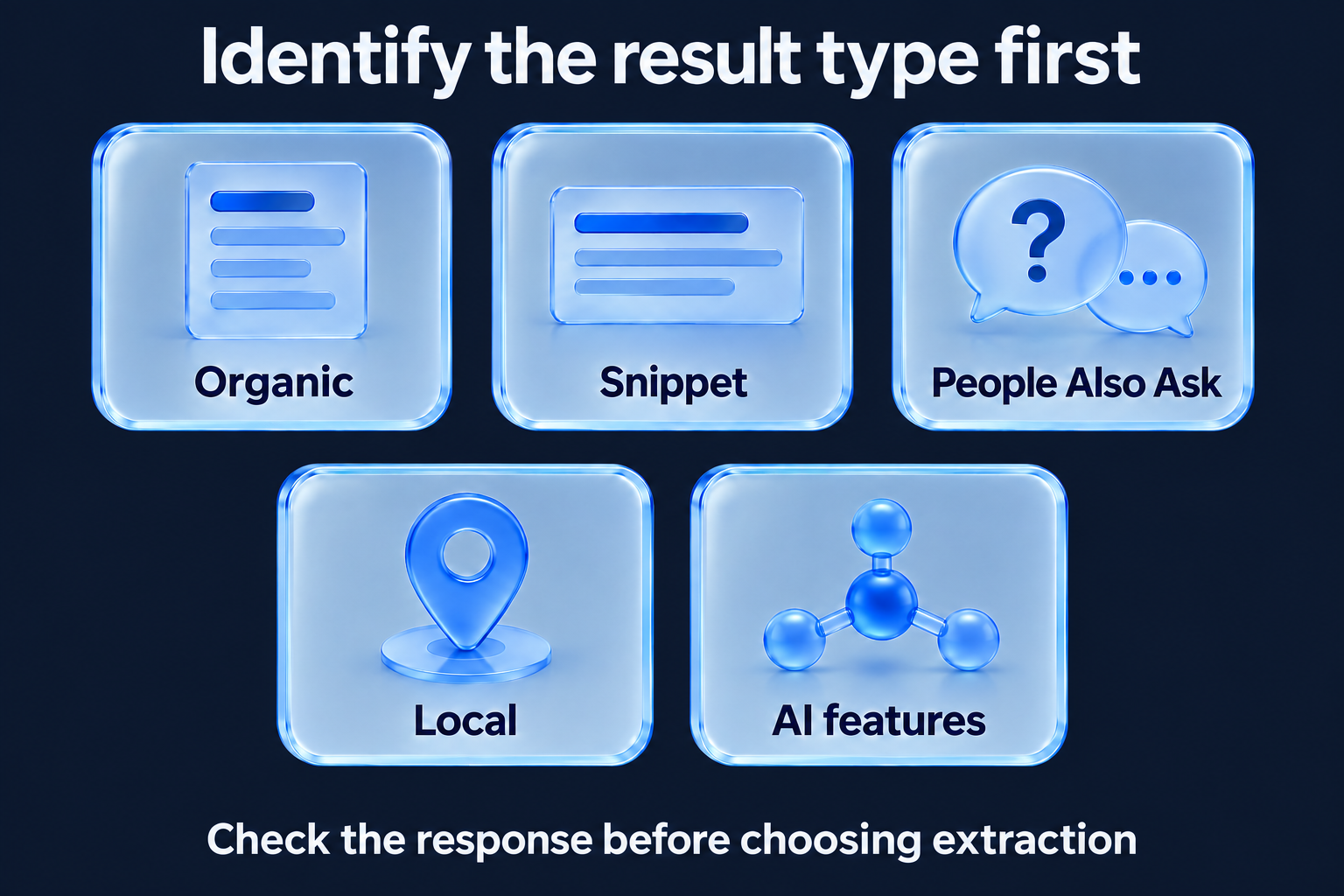
Separate organic results, featured snippets, People Also Ask, local results, and AI features before extraction. Inspect the actual response to decide whether plain HTML is sufficient or browser rendering and interaction are needed. CSS selectors and feature availability change; an empty selector match is not proof that the underlying information does not exist.
Organic results are the starting point. The data that most teams actually need for competitive intelligence is in the SERP features — People Also Ask boxes, featured snippets, and the local pack. These require different selectors and fail silently when Google changes its HTML structure.
The selectors below are verified against the current Google DOM as of May 2026. Google obfuscates class names periodically, so treat these as the current state — not permanent infrastructure.
# SERP feature extraction — People Also Ask, Featured Snippet, Local Pack
# Selectors verified May 2026 — Google updates these periodically

from bs4 import BeautifulSoup

def extract_people_also_ask(soup: BeautifulSoup) -> list[str]:
    # PAA questions appear in expandable accordion divs
    paa_questions = []
    for item in soup.select("div[data-q]"):
        question = item.get("data-q", "").strip()
        if question:
            paa_questions.append(question)

    # Fallback selector for PAA blocks
    if not paa_questions:
        for item in soup.select(".related-question-pair span"):
            text = item.get_text(strip=True)
            if text and "?" in text:
                paa_questions.append(text)

    return paa_questions

def extract_featured_snippet(soup: BeautifulSoup) -> dict | None:
    # Featured snippets appear before organic results in a dedicated block
    snippet_block = soup.select_one(".xpdopen, [data-attrid='wa:/description']")
    if not snippet_block:
        return None

    text = snippet_block.get_text(separator=" ", strip=True)
    return {"type": "featured_snippet", "content": text[:500]}

def extract_local_pack(soup: BeautifulSoup) -> list[dict]:
    # Local pack results — requires geo-targeted residential IPs for accuracy
    local_results = []
    for item in soup.select(".VkpGBb, .rllt__details"):
        name_tag    = item.select_one(".dbg0pd, .OSrXXb")
        rating_tag  = item.select_one(".BTtC6e, .yi40Hd")
        address_tag = item.select_one(".rllt__wrapped .rllt__details div:nth-child(3)")

        if name_tag:
            local_results.append({
                "name":    name_tag.get_text(strip=True),
                "rating":  rating_tag.get_text(strip=True) if rating_tag else "",
                "address": address_tag.get_text(strip=True) if address_tag else "",
            })
    return local_results

def extract_ai_overview_present(soup: BeautifulSoup) -> bool:
    # Detect if Google returned an AI Overview block — DOM structure differs
    # Skip parsing if present and httpx can't render the full content
    ai_indicators = soup.select(
        "[data-ved*='ai-overview'], .M8OgIe, #ai-overview"
    )
    return len(ai_indicators) > 0

def extract_all_serp_features(soup: BeautifulSoup, query: str) -> dict:
    return {
        "query":           query,
        "paa":             extract_people_also_ask(soup),
        "featured_snippet":extract_featured_snippet(soup),
        "local_pack":      extract_local_pack(soup),
        "has_ai_overview": extract_ai_overview_present(soup),
    }
The SERP features extraction — People Also Ask, featured snippet data, and local pack — all depend on having a clean, non-degraded response. The validate_serp_response() function from Method 1 must run before any feature extraction. A degraded SERP has none of these blocks, and your extraction functions will return empty data without errors.
For local pack extraction specifically, the results only reflect your target location when you use geo-targeted residential IPs with the city parameter — a residential IP from New York returns a different local pack than one from Dallas for the same query. (Source: apiserpent.com, May 2026)
The async implementation in Method 2 handles concurrency, but production-scale Google scraping has additional constraints.
Five concurrent workers is the practical ceiling before behavioral detection escalates. Beyond that, distributing across multiple independent sessions — each with its own sessid — is more reliable than increasing concurrency per session. At five workers with 1.5s average Poisson delay, expect roughly 3 requests per second, about 250,000 queries per day at maximum throughput.
Bandwidth planning: a Google SERP page is 150-200KB. At 10,000 daily queries that's 1.5-2GB per day, the 30GB plan at $1.90/GB covers roughly 15-20 days of continuous collection at that volume.
The quality check that matters at scale: run validate_serp_response() as a counter. If your validation failure rate climbs above 5%, reduce concurrency or increase delays before Google's detection models adapt to your traffic pattern.
Use code FIRSTPURCHASE for 80% off your first month — enough bandwidth to validate the complete pipeline end-to-end before committing to a recurring plan.
The tutorial that taught you requests+BeautifulSoup wasn't wrong. It just didn't tell you what happens after request 20.
The 2026 stack for scraping Google search results is httpx with HTTP/2 for the TLS layer, rotating residential proxies for the IP layer, gl and hl parameters locked for reproducibility, and validate_serp_response() before any parsing. Those four elements together produce a pipeline that runs. Any one of them missing produces a pipeline that looks like it runs but generates data you can't trust.
The silent success is the expensive failure. A 429 stops your script — you fix it and move on. A degraded SERP fills your database with incomplete records that look valid until you do QA three days later. The validation function is the three lines of code that separates a scraper from a data pipeline.
For teams running residential proxy google scraping at production scale, the bottleneck stops being access and starts being data engineering — what you do with the rankings, PAA questions, and featured snippet content once it's in a clean CSV. That's the problem worth spending time on.
Check the most Frequently Asked Questions
Is it legal to scrape Google search results?
Why does my Google scraper return empty results even with a 200 OK response?
Do I need a headless browser to scrape Google search results?
How many Google searches can I scrape per day with residential proxies?
What is the difference between scraping Google search results and using the Google Search API?
Here’s how Profile Peeker enables organizations to transform profile data into business opportunities.
Scale your scraping strategy with high-quality residential IPs ensuring stable connections, low latency, and cost-effective results.
Ask AI about Magnetic Proxy