


Proxy vs. VPN: What's the Difference and Which One Do You Actually Need?
Proxy Academy

Proxy vs. VPN: What's the Difference and Which One Do You Actually Need?

VPNs and proxies both hide your IP — but they're built for opposite architectures. Learn when each tool wins and why VPNs fail at scraping scale.

Every comparison you'll find online reaches the same conclusion: VPNs are safer, VPNs encrypt everything, VPNs win. For individual users browsing the web, that's true. For technical teams running data pipelines, it's exactly backwards.

A VPN will get your scraper blocked in minutes. Not because VPNs are bad tools — they're excellent tools, just not for this job. The proxy vs VPN debate comes down to one architectural fact that most comparisons miss entirely: a VPN gives you one IP address at a time. A residential proxy pool gives you one IP address per request. That difference explains everything.

What Is a Proxy Server?

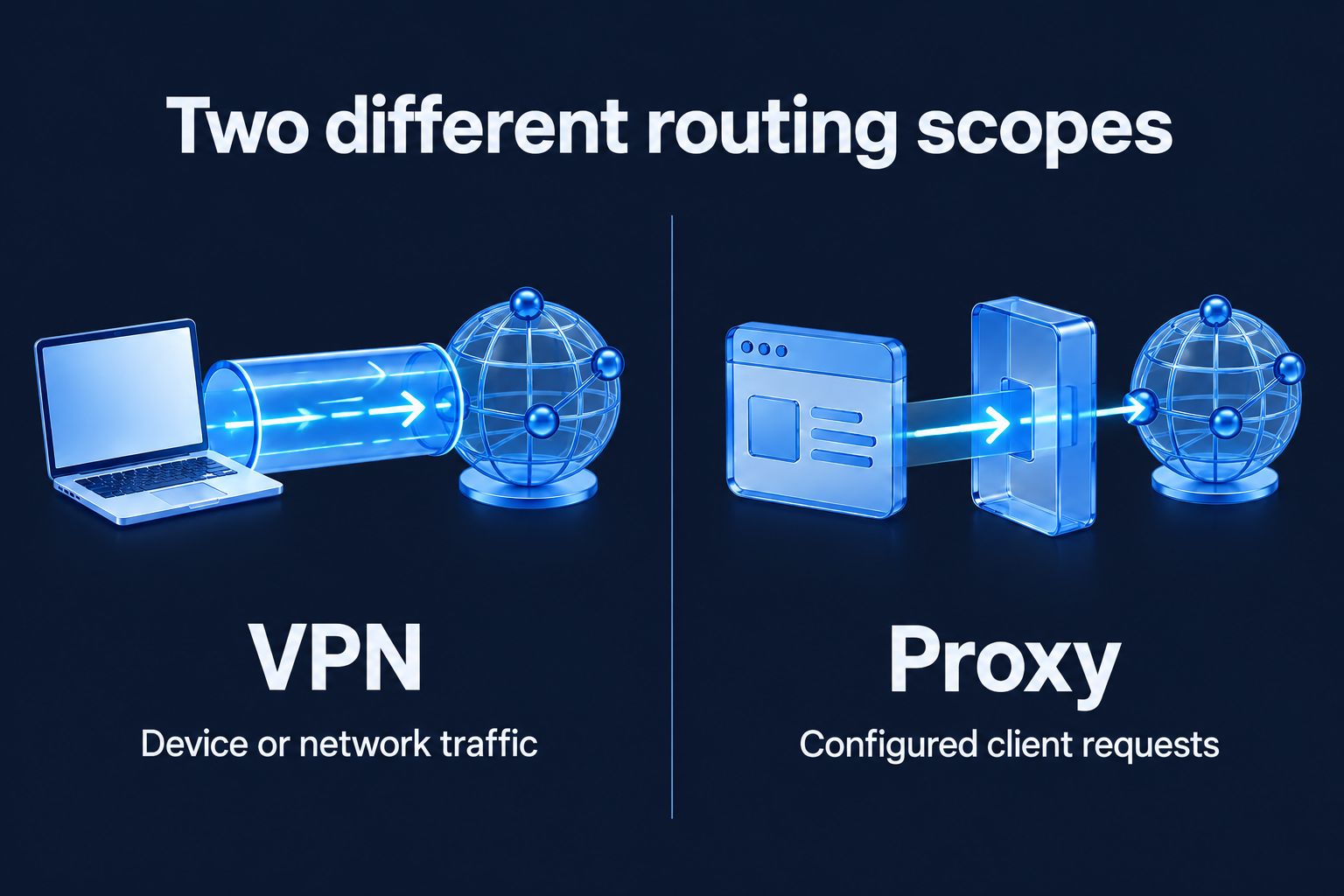
A proxy server sits between your application and the internet. When your code makes a request through a proxy, the proxy forwards it using its own IP address, the destination server sees the proxy's IP, not yours. Your real IP stays hidden.

What is a residential proxy? A residential proxy routes requests through real IP addresses assigned by ISPs to actual consumer devices — phones, laptops, home routers. When a website checks the IP making a request, it sees an address that belongs to a real household on a real ISP network. That's why residential proxies pass anti-bot detection where datacenter IPs get flagged: the IP's origin is genuine, not a commercial server farm.

The three proxy types worth understanding:

  • Residential proxies, real ISP-assigned consumer IPs. Highest trust score, hardest to detect.
  • Datacenter proxies, IPs from commercial server infrastructure. Faster and cheaper, but flagged by most serious anti-bot systems.
  • SOCKS5 proxies, protocol-level proxies that handle any traffic type, not just HTTP. More flexible for non-web use cases.

Proxies operate at the application level. You configure a proxy for a specific app, browser, or script, not for your entire device. Everything else on your machine connects normally.

QC-1: "A VPN and a residential proxy pool solve structurally different problems. A VPN replaces one device's IP address for one user's browsing session. A residential proxy pool replaces the IP address of each individual request with a different residential IP from a real consumer device, enabling thousands of simultaneous requests that each appear to originate from a different person in a different location."

What type of proxy gives the best performance for data collection? Rotating residential proxies, where each request routes through a different real consumer IP, achieve the highest success rates against modern anti-bot systems. At Magnetic Proxy's residential network, this translates to a 99.95% average success rate and 0.6s average response time across production pipelines.

QC-2: "For web scraping, automation, and data collection at scale, VPNs fail not because of their security model but because of their architecture. A VPN gives you one IP at a time. A residential proxy pool gives you one IP per request. At 10,000 daily requests, the difference is the gap between a blocked pipeline and one that runs reliably."
QC-3: "The proxy vs. VPN decision comes down to the question: are you protecting one human's browsing session, or distributing thousands of automated requests across thousands of different IP addresses? VPNs are built for the first case. Residential proxy pools are built for the second."

What Is a VPN?

A VPN — Virtual Private Network — creates an encrypted tunnel between your device and a VPN server. All traffic from your device routes through that tunnel: your browser, your email client, your apps, everything. The destination server sees the VPN server's IP, not yours.

The critical word is "all." A VPN operates at the OS level, not the application level. It doesn't route one script's traffic while leaving other connections untouched. It captures everything your device sends. That's its strength for privacy, and its structural limitation for technical use cases.

Encryption is the defining feature of a VPN. The traffic tunneling between your device and the VPN server is encrypted end-to-end, which means IP masking comes with full data protection. Anyone monitoring your network connection — your ISP, a public Wi-Fi operator, a network-level attacker, sees encrypted traffic going to a VPN server, nothing more.

That encryption is exactly what makes VPNs the right tool for protecting a human user's browsing session. It's also what makes them the wrong architecture for a pipeline that needs to look like thousands of different users making individual requests.

Understanding what is a proxy vs VPN starts here: VPNs were built for protecting one person's connection to the internet. They're excellent at that job. The question is whether that job is the job you're actually trying to do.

The Architecture Gap - Why These Tools Solve Different Problems

proxy vs vpn for web scraping - pipeline showing vpn pattern detection vs residential proxy rotation

Here's the operational reality that most proxy vs. VPN comparisons skip.

A team running a price monitoring pipeline against 50 e-commerce sites decides to use a VPN for "IP protection." They set up 5 VPN server locations and rotate between them manually. The pipeline runs 10,000 queries per day.

What anti-bot systems see: the same 5 IP addresses making thousands of requests, rotating on a predictable schedule. Each IP generates request volumes that no human user ever generates. The pattern is flagged within minutes. By end of day, all 5 IPs are blocked.

Warning: If you're running a scraping pipeline with a VPN, you're not hiding — you're rotating between a handful of flagged IPs in a predictable pattern. Anti-bot systems identify this in minutes. The solution isn't a faster VPN. It's a different architecture.

Now the same pipeline with rotating residential proxies. Each request routes through a different residential proxy — a real consumer IP on a real ISP network. The concurrent requests draw from an IP pool of thousands of addresses. The per-request rotation means no single IP generates more than one or two requests per day. Anti-bot systems see thousands of different users making occasional requests. That's indistinguishable from organic traffic.

In production testing across Magnetic Proxy's residential network:

Method IPs Available Concurrent Requests Success Rate Avg Response
VPN (5 servers, manual rotation) 5 1 (sequential) ~12% at scale 0.8s
Datacenter proxy 1 per session Unlimited ~35% 0.4s
MP Residential proxy Thousands (rotating) Unlimited 99.95% 0.6s

The difference isn't configuration. It's architecture. A VPN is a single-user privacy tool running on one device. A residential proxy pool is a distributed infrastructure built for high-volume, multi-session request distribution. Using a VPN for scraping at scale isn't a corner case — it's the wrong tool for the job.

For a deeper look at how application-level routing differs from OS-level routing in practice, and how anti-bot detection systems evaluate each approach, the FreeCodeCamp technical breakdown covers the network-layer details without commercial bias. (Source: FreeCodeCamp, 2025)

Magnetic Proxy's residential network handles the rotation automatically — one residential proxy per request, 99.95% success rate, 0.6s average response time.

When to Use a Proxy vs. a VPN: The Decision Framework

when to use proxy instead of vpn — decision tree showing personal privacy vs automated data collection

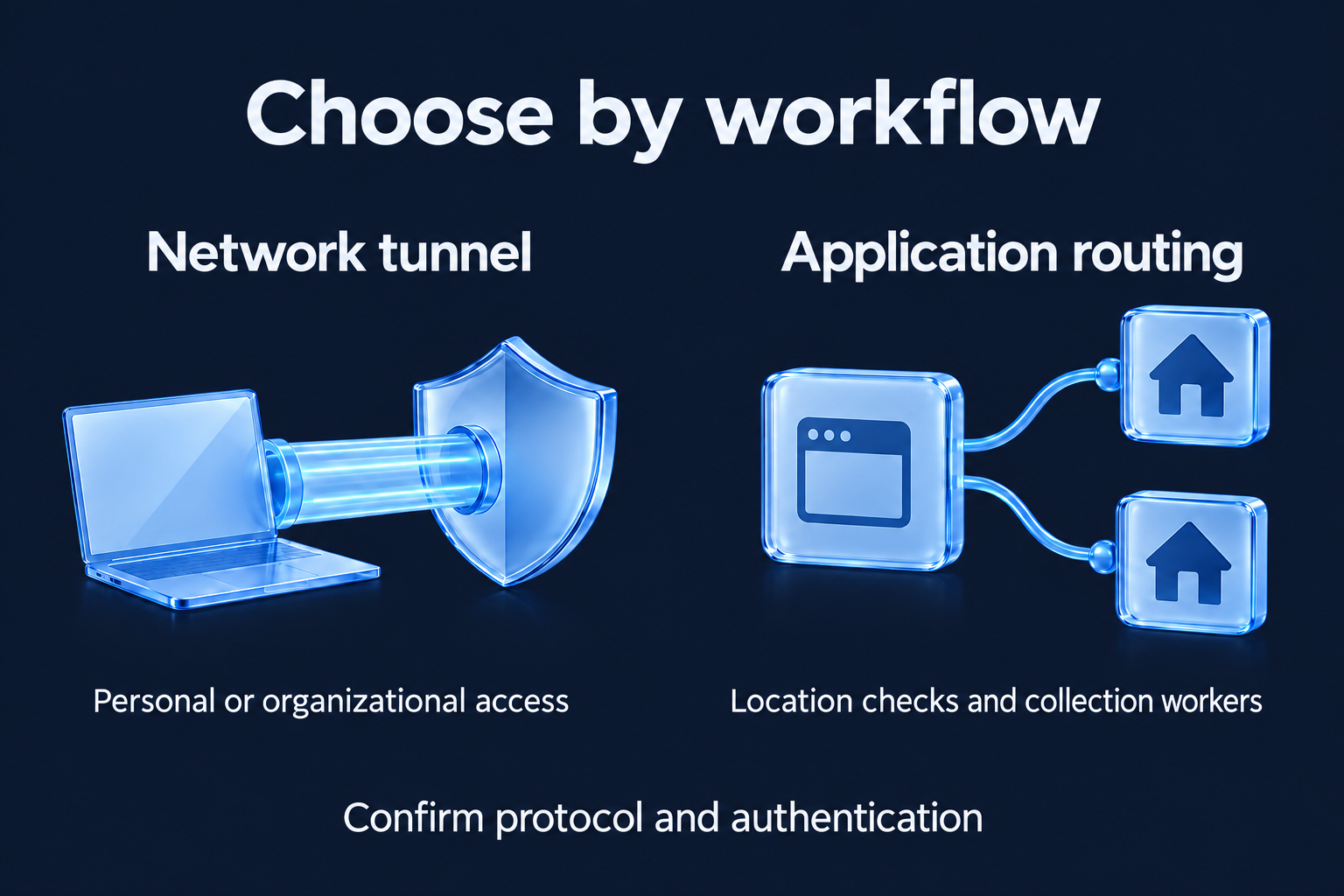
When should you use a proxy instead of a VPN?

Use a residential proxy, not a VPN, when:

  1. You're running scraping or automation at scale — any pipeline making more than a few hundred daily requests needs per-request IP rotation that a VPN cannot provide.
  2. You need requests to appear as different users — ad verification, SERP tracking, and price monitoring require each request to look like it comes from a distinct person in a specific location.
  3. You need city-level geo-targeting — VPNs let you pick a country server. Geo-targeted residential IPs let you target a specific city, state, or region with real consumer IPs from that location.
  4. You're running concurrent requests simultaneously — a VPN processes requests sequentially through one connection. A proxy pool handles thousands of parallel requests, each through a different IP.
  5. You're building AI data pipelines — LLM training data collection, web crawling for model fine-tuning, and real-time data feeds all require the distributed IP architecture that only proxy pools provide.

Use a VPN when:

  • Protecting your browsing privacy on public Wi-Fi networks
  • Accessing geo-restricted streaming content as an individual user
  • Working remotely and connecting to corporate networks securely
  • Protecting sensitive data on untrusted connections

Use residential proxies when:

  • Running web scraping, data collection, or automation pipelines
  • Tracking search rankings across multiple cities or regions
  • Verifying how ads appear to users in specific locations
  • Monitoring competitor pricing across markets
  • Building any workflow requiring simultaneous requests from distinct IP addresses

Proxy vs. VPN: Side-by-Side Comparison

The table below covers the dimensions that actually matter for choosing between the two tools.

Dimension Residential Proxy VPN Notes
Routing level Application OS-level (all traffic) Proxies affect one app/script — VPNs affect the whole device
IPs per session Thousands (rotating) 1 at a time Core architectural difference for scraping at scale
Encryption None by default Full end-to-end VPN encrypts all traffic — proxies focus on IP routing
Concurrent requests Unlimited Sequential (1 IP) Proxy pools distribute load — VPNs bottleneck at one IP
Geo-targeting precision Country / Region / City Country (server location) Residential proxies support city-level targeting with real ISP IPs
Anti-bot detection Passes (residential IPs) Flagged at scale VPN IPs create detectable patterns — residential IPs don't
Best for Scraping, automation, rank tracking, ad verification, price monitoring, AI pipelines Personal privacy, public Wi-Fi protection, corporate remote access, geo-restricted content
Speed 0.6s avg (MP) Slower (encryption overhead) No encryption = lower latency for proxy requests

According to the Octoparse technical analysis of VPN vs. proxy behavior in scraping pipelines, 9 out of 10 times a VPN will fail once scraping volume scales — not because of configuration errors but because of the fundamental mismatch between VPN architecture and the requirements of distributed automated traffic. (Source: Octoparse, January 2026)

Can You Use Both? (And When It Makes Sense)

The short answer: yes, but only when the use cases are genuinely separate.

A research team might connect through a corporate VPN for encrypted access to internal systems, then route their scraping scripts through residential proxies for data collection. The VPN protects the corporate connection. The proxies handle the automated requests, at different network levels, so they don't conflict.

What doesn't work: running a proxy through a VPN hoping to get "double protection" for scraping. The VPN adds encryption overhead and latency without adding IP diversity. Your requests still originate from the VPN server's IP before hitting the proxy — and that VPN IP is visible to the proxy provider. You get more complexity without the anti-detection benefit.

For most technical teams asking what is a proxy vs VPN in a production context, the right setup is simpler: use what is a residential proxy infrastructure for automated pipelines, and a VPN for personal browsing if privacy matters to you. No need to layer them for scraping purposes.

The Right Tool Depends on Who's Making the Request

The proxy vs. VPN debate has a clean answer once you ask the right question: who is making the requests, and how many at once?

A human browsing the web needs privacy and encryption for one continuous session. A VPN is the right tool. A pipeline scraping product prices across 200 URLs needs each request to appear as a different organic user from a different location. A residential proxy pool is the right tool.

Saying a VPN and a residential proxy are interchangeable because both mask your IP is like saying a bicycle and a truck are the same because both have wheels. The architecture, the scale, and the use case are structurally different.

For teams running when to use proxy instead of vpn as a real production question — the answer is any time your requests need to look like they're coming from more than one person. Use code FIRSTPURCHASE for 80% off your first month of Magnetic Proxy's residential network and validate the difference against your actual target domains.

Frequently Asked Questions

Check the most Frequently Asked Questions

What is the main difference between a proxy and a VPN?

Is a proxy faster than a VPN?

Can a proxy replace a VPN for privacy?

Why do VPNs fail for web scraping at scale?

What type of proxy is best for web scraping and data collection?

Latest Posts

Here’s how Profile Peeker enables organizations to transform profile data into business opportunities.