



Scale your scraping strategy with high-quality residential IPs ensuring stable connections, low latency, and cost-effective results.
Ask AI about Magnetic Proxy





© 2026 Magnetic Proxy. All rights reserved.



Digital ad fraud exceeded $100 billion globally in 2026. Most ad verification teams know the number. Fewer understand why their verification tools keep reporting clean placements while their CPA climbs and attribution data stops making sense.
The answer isn't a more sophisticated detection algorithm. It's the IP infrastructure the tool is running on. Ad verification proxies built on datacenter IPs have a structural blind spot: fraudsters and ad networks maintain continuously updated databases of datacenter IP ranges. When your auditor makes a request from one of those ranges, cloaking activates. The system serves a clean, compliant page. Your tool reports no issues. The fraud keeps running against real users.
This is the problem that residential ad verification proxies solve — not by being smarter, but by being invisible to the systems that hide fraud from auditors.
Most ad verification workflows were built on datacenter proxies. They're fast, cheap, and easy to provision at scale. The problem is structural: ad networks and fraudulent publishers have known datacenter IP ranges for years, and they use that knowledge actively.
Why don't datacenter proxies work for ad verification?The filtering operates at three separate levels. First, ad networks themselves serve different inventory to recognized datacenter ranges — premium, brand-safe placements to auditor IPs, lower-quality inventory to actual consumers. Second, fraudulent publishers trigger cloaking when they detect non-residential traffic, serving clean compliant content to the auditor while real users see the fraud. Third, geo-targeting verification breaks entirely because datacenter IP detection systems don't map those IPs to real consumer locations at the city level.
The 2026 evolution of this problem is environment fingerprinting. Fraudsters no longer rely only on IP range databases. They analyze the full request environment: browser headers, TLS fingerprint, request timing patterns, and behavioral signals. A verification bot running on a datacenter IP with standard automation headers doesn't just fail the IP check, it fails the behavioral check too. The combination makes modern fraud invisible to traditional verification stacks.
Warning: If your ad verification tool is reporting clean placements but your CPA is climbing and your attribution data doesn't make sense, the problem likely isn't your detection tool, it's the IP infrastructure it's running on. Fraudsters don't hide from smart detection algorithms. They hide from auditor IP ranges.
ISP-assigned residential IPs solve this at the root. A request routed through a genuine consumer IP on a real ISP network passes every classification check that cloaking systems use. The fraud has no trigger to activate. It renders for the auditor exactly as it renders for the user.
QC-1: "Ad verification proxies work by routing audit requests through residential IP addresses assigned by consumer ISPs to real devices. Fraudsters and ad networks maintain continuously updated databases of datacenter IP ranges. When a request arrives from a datacenter IP, cloaking systems activate and serve a clean, compliant version of the page. When the same request arrives from a residential IP, no cloaking trigger fires, the system sees what it classifies as an ordinary consumer visit, and the fraudulent content renders as intended."
QC-2: "The distinction between rotating and sticky session modes matters specifically for ad verification. Rotating residential proxies — a fresh IP per request — are correct for large-scale placement scanning where each check is independent. Sticky sessions, configured via the sessid parameter, are required for verifying the full user journey: ad impression, click-through, and landing page load must all originate from the same residential IP for the cloaking system to have no reason to activate between steps."
QC-3: "Digital ad fraud exceeded $100 billion globally in 2026, according to industry estimates. The mechanism is straightforward: verification tools built on datacenter infrastructure see a sanitized version of the ad ecosystem, while real residential users see the fraud. The gap between what the auditor sees and what the consumer sees is precisely the space where ad fraud operates."
Digital ad fraud losses now exceed $100 billion annually, roughly one in five ad dollars funding bot traffic, fake clicks, or impression manipulation rather than reaching real customers. (Source: Improvado, 2026)
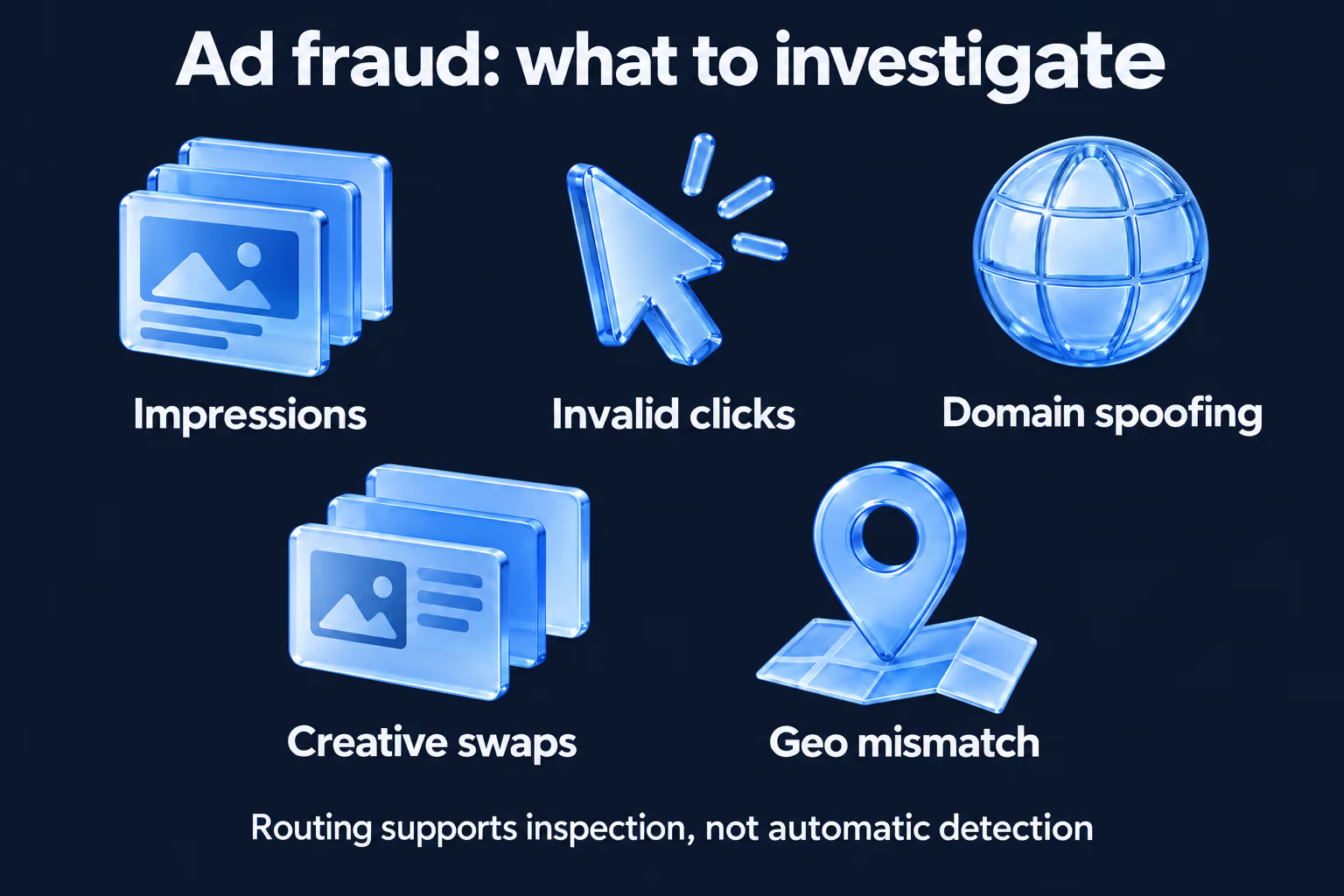
Five categories to investigate: impression fraud and pixel stuffing; click fraud and invalid traffic; domain spoofing; creative swapping or cloaking; and geographic mismatch. The diagram organizes inspection categories; a proxy alone does not detect or prevent each type.
What are ad verification proxies used to detect?
Residential ad verification proxies expose fraud types that datacenter ad verification proxies systematically miss. These are the five categories where the cloaking gap creates the largest verification blind spot:
Here's the operational reality of how cloaking works and why residential IPs neutralize it.
An ad ops team runs their standard verification workflow against a display campaign targeting US consumers. Their tool uses datacenter proxies provisioned in US server locations. Every placement comes back clean. Click-through rates look normal. Then conversion data starts degrading, CPAs climbing, attribution discrepancies growing. A second pass using residential proxies from real consumer IPs in Chicago and Miami returns different results entirely: an active creative swap on three publisher placements, a landing page serving a malware redirect to a residential Chicago IP that renders a compliant page to the datacenter range.
The fraud was always there. The first verification pass just couldn't see it.
In production ad verification workflows using Magnetic Proxy's residential network:
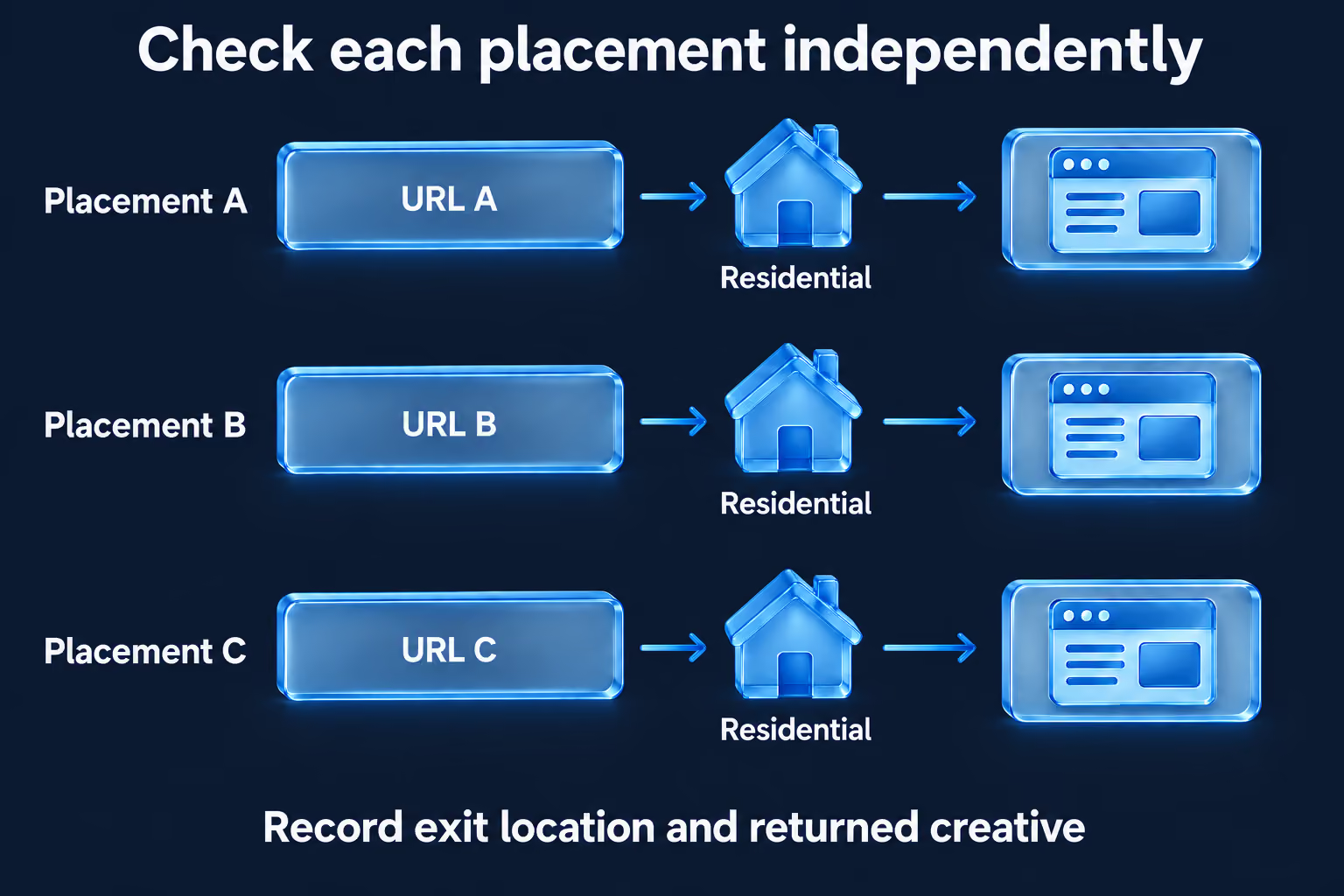
Placement scanning treats each URL as an independent check. The parallel paths represent separate routed requests; record the observed exit location and returned creative for each check. IP rotation does not guarantee that a target cannot recognize the verification workflow.
For scanning large numbers of ad placements across a publisher network, rotating ad verification proxies are the correct configuration. Each verification request routes through a different residential IP, maximum diversity, no pattern that flags the pipeline as an auditor. A fresh residential IP per request means each check arrives with no behavioral history that cloaking systems can use to classify it as a verification tool.
The cc, rg, and city parameters in the Magnetic Proxy username string enable geo-targeting by country, region, and city — placing each verification request inside the exact geographic market the campaign targets. A campaign verified from a real Chicago residential IP produces a different ad stack than the same campaign verified from a New York datacenter server, and that difference is where geo-mismatch fraud hides.

Journey verification follows ad impression, click-through, and landing page as one sequence. A consistent sessid requests session continuity, while sesstime controls its duration in seconds. Continuity is best effort: the exit can change if unavailable. hardcountry constrains country fallback, not exact-city persistence.
For verifying the complete user journey, from ad impression through click-through to landing page load — sticky sessions are required. The choice between sticky vs. rotating session modes determines whether your verification pipeline catches placement-level fraud or journey-level fraud.
Here's why journey verification requires sticky sessions: if the IP changes between the ad impression and the landing page request, a sophisticated cloaking system can trigger a secondary layer that re-sanitizes the landing page. IP A looks like a consumer. IP B, arriving seconds later with no connecting history, can trigger the cloaking system again. Brand safety monitoring for full journeys requires the same residential IP across all steps — sessid in the username string holds the IP constant for the duration configured by sesstime. For a standard ad-to-landing-page journey, 300 seconds (5 minutes) is sufficient and minimizes the exposure window during which the IP accumulates request patterns.
Affiliate compliance checks follow the same logic: verifying that an affiliate link doesn't hijack traffic or redirect through unauthorized domains requires the same residential IP across the entire redirect chain. Domain spoofing detection in redirect chains is impossible if the IP changes mid-chain.
Python implementation using Magnetic Proxy's residential network. Two modes: rotating for placement scanning, sticky sessions for journey verification with geo-targeting per market.
# Ad verification pipeline using Magnetic Proxy residential network
# Rotating mode: fresh residential IP per request — large-scale placement scanning
# Sticky mode: same residential IP across all steps — full journey verification

import requests
import time
import uuid
import random
from typing import Optional
from dataclasses import dataclass, field

MP_USERNAME = "YOURUSERNAME"
MP_PASSWORD = "YOURPASSWORD"
MP_HOST     = "rs.magneticproxy.net"
MP_PORT     = "443"

@dataclass
class VerificationResult:
    url:          str
    status_code:  int
    mode:         str
    geo:          str
    session_id:   Optional[str] = None
    creative_hash: Optional[str] = None
    redirect_chain: list = field(default_factory=list)
    flagged:      bool = False
    flag_reason:  str = ""

def build_proxy_url(
    country:    str = "us",
    region:     Optional[str] = None,
    city:       Optional[str] = None,
    sticky:     bool = False,
    session_id: Optional[str] = None,
    sesstime:   int = 300,
) -> str:
    # Encode routing parameters directly in the username string
    user = f"customer-{MP_USERNAME}-cc-{country}"

    if region:
        user += f"-rg-{region.replace(' ', '_').lower()}"
    if city:
        user += f"-city-{city.replace(' ', '_').lower()}"

    if sticky:
        sid = session_id or str(uuid.uuid4()).replace("-", "")[:12]
        user += f"-sessid-{sid}-sesstime-{sesstime}"

    return f"https://{user}:{MP_PASSWORD}@{MP_HOST}:{MP_PORT}"

def scan_placement(
    url:     str,
    country: str = "us",
    city:    Optional[str] = None,
    region:  Optional[str] = None,
) -> VerificationResult:
    # Rotating mode — fresh residential IP per placement check
    proxy_url = build_proxy_url(country=country, region=region, city=city)
    proxies   = {"https": proxy_url, "http": proxy_url}
    geo_label = f"{country}/{city or region or 'any'}"

    time.sleep(random.uniform(1.0, 2.5))  # Human-plausible request cadence

    try:
        response = requests.get(
            url, proxies=proxies, timeout=15,
            allow_redirects=True,
            headers={
                "User-Agent": (
                    "Mozilla/5.0 (Windows NT 10.0; Win64; x64) "
                    "AppleWebKit/537.36 (KHTML, like Gecko) "
                    "Chrome/124.0.0.0 Safari/537.36"
                )
            }
        )
        redirect_chain = [r.url for r in response.history]

        return VerificationResult(
            url=url,
            status_code=response.status_code,
            mode="rotating",
            geo=geo_label,
            redirect_chain=redirect_chain,
            creative_hash=str(hash(response.text[:500])),
        )
    except Exception as e:
        return VerificationResult(
            url=url, status_code=0, mode="rotating",
            geo=geo_label, flagged=True, flag_reason=str(e)
        )

def verify_journey(
    ad_url:       str,
    landing_url:  str,
    country:      str = "us",
    city:         Optional[str] = None,
    region:       Optional[str] = None,
    sesstime:     int = 300,
) -> dict:
    # Sticky mode — same residential IP across the full ad-to-landing journey
    # sesstime=300: 5-minute window, sufficient for standard journeys
    session_id = str(uuid.uuid4()).replace("-", "")[:12]
    geo_label  = f"{country}/{city or region or 'any'}"

    print(f"\nJourney verification — session: {session_id} | geo: {geo_label}")

    steps = [
        ("ad_impression", ad_url),
        ("landing_page",  landing_url),
    ]
    results = []

    for step_name, url in steps:
        proxy_url = build_proxy_url(
            country=country, region=region, city=city,
            sticky=True, session_id=session_id, sesstime=sesstime
        )
        proxies = {"https": proxy_url, "http": proxy_url}

        try:
            response = requests.get(
                url, proxies=proxies, timeout=15,
                allow_redirects=True,
                headers={
                    "User-Agent": (
                        "Mozilla/5.0 (Windows NT 10.0; Win64; x64) "
                        "AppleWebKit/537.36 (KHTML, like Gecko) "
                        "Chrome/124.0.0.0 Safari/537.36"
                    )
                }
            )
            flagged     = response.status_code != 200
            flag_reason = f"HTTP {response.status_code}" if flagged else ""
            redirect_chain = [r.url for r in response.history]

            # Flag unexpected redirects in affiliate/landing page chains
            if len(redirect_chain) > 3:
                flagged     = True
                flag_reason = f"Unexpected redirect chain depth: {len(redirect_chain)}"

            results.append(VerificationResult(
                url=url, status_code=response.status_code,
                mode="sticky", geo=geo_label,
                session_id=session_id,
                creative_hash=str(hash(response.text[:500])),
                redirect_chain=redirect_chain,
                flagged=flagged, flag_reason=flag_reason,
            ))
            print(f"  ✓ {step_name}: {response.status_code} "
                  f"({'FLAGGED: ' + flag_reason if flagged else 'clean'})")

        except Exception as e:
            results.append(VerificationResult(
                url=url, status_code=0, mode="sticky",
                geo=geo_label, session_id=session_id,
                flagged=True, flag_reason=str(e)
            ))

    return {"session_id": session_id, "geo": geo_label, "steps": results}

def run_verification_campaign(
    placements:   list[str],
    journey_pairs: list[tuple[str, str]],
    target_markets: list[dict],
) -> dict:
    print(f"Scanning {len(placements)} placements across {len(target_markets)} markets...")
    placement_results = []
    for url in placements:
        for market in target_markets:
            result = scan_placement(url, **market)
            placement_results.append(result)
            status = "FLAGGED" if result.flagged else "clean"
            print(f"  {status}: {url[:60]} [{result.geo}]")

    print(f"\nVerifying {len(journey_pairs)} ad journeys...")
    journey_results = []
    for ad_url, landing_url in journey_pairs:
        for market in target_markets:
            result = verify_journey(ad_url, landing_url, **market)
            journey_results.append(result)

    flagged_placements = [r for r in placement_results if r.flagged]
    flagged_journeys   = [
        r for jr in journey_results
        for r in jr["steps"] if r.flagged
    ]
    return {
        "total_placements_checked": len(placement_results),
        "flagged_placements":       len(flagged_placements),
        "total_journeys_checked":   len(journey_results),
        "flagged_journey_steps":    len(flagged_journeys),
        "placement_results":        placement_results,
        "journey_results":          journey_results,
    }

if __name__ == "__main__":
    # Target markets for geo-targeted ad verification
    markets = [
        {"country": "us", "city": "chicago"},
        {"country": "us", "city": "miami"},
        {"country": "us", "city": "new_york"},
    ]

    # Replace with actual campaign placement URLs
    placements = [
        "https://example-publisher.com/ad-placement-1",
        "https://example-publisher.com/ad-placement-2",
    ]

    # Replace with actual ad URL + landing page pairs
    journeys = [
        ("https://ad-network.com/click?campaign=123",
         "https://advertiser-landing.com/offer"),
    ]

    report = run_verification_campaign(placements, journeys, markets)

    print(f"\nVerification complete:")
    print(f"  Placements checked:   {report['total_placements_checked']}")
    print(f"  Placements flagged:   {report['flagged_placements']}")
    print(f"  Journey steps checked: {report['total_journeys_checked']}")
    print(f"  Journey steps flagged: {report['flagged_journey_steps']}")
Keep exploring: See the General Purpose Premium Capsule for the relevant proxy setup, then read How Does Ad Verification Work? for the technical foundation.
Replace YOURUSERNAME and YOURPASSWORD with your Magnetic Proxy credentials from the dashboard. The pipeline scans placements with fresh residential IPs per check and verifies journeys with IP-consistent sticky sessions. Replace the example URLs with your actual campaign targets.
Start catching cloaked fraud with real residential IPs — use code FIRSTPURCHASE for 80% off your first month at magneticproxy.com/pricing.
According to the IAB Tech Lab Invalid Traffic (IVT) standards, sophisticated invalid traffic includes bot traffic that mimics human behavior specifically to evade detection systems, which is why the proxy infrastructure matters as much as the detection logic. (Source: IAB Tech Lab, 2025)
Quick reference for the five primary ad verification workflows and the corresponding Magnetic Proxy configuration for each.
The $100 billion ad fraud problem isn't primarily a detection problem. It's a visibility problem. Fraudsters don't need to be smarter than your detection tool, they just need to recognize your auditor's IP range and serve a clean page.
Residential ad verification proxies close that gap not by outsmarting fraud detection evasion, but by removing the signal that triggers it. When your verification requests originate from real ISP-assigned consumer IPs, every cloaking trigger that hides fraud from datacenter auditors fails to activate. The fraud has no information that tells it to hide.
The practical consequence: ad verification proxies built on residential IP infrastructure find fraud that datacenter-based tools structurally cannot.
For ad ops teams, brand safety analysts, and affiliate compliance teams running residential proxies for ad verification at scale, the combination of rotating mode for placement scanning and sticky sessions for journey verification covers the full surface area of modern ad fraud, from impression manipulation to creative swapping to geo-mismatch fraud.
Check the most Frequently Asked Questions
What are ad verification proxies?
Why don't datacenter proxies work for ad verification?
How do ad verification proxies detect cloaking?
What is the difference between rotating and sticky proxies for ad verification?
How many IPs do I need for large-scale ad verification?
Here’s how Profile Peeker enables organizations to transform profile data into business opportunities.
Scale your scraping strategy with high-quality residential IPs ensuring stable connections, low latency, and cost-effective results.
Ask AI about Magnetic Proxy