



Scale your scraping strategy with high-quality residential IPs ensuring stable connections, low latency, and cost-effective results.
Ask AI about Magnetic Proxy





© 2026 Magnetic Proxy. All rights reserved.

For modern sales and marketing teams, relying on outdated, purchased email lists is a massive drain on ROI. The most accurate, up-to-date information about your potential clients isn't found in a stagnant database—it's live on the internet.
Local business directories (like Yelp, Yellow Pages, TripAdvisor, and industry-specific portals) are goldmines for highly targeted prospect data. However, extracting this data at scale requires a precise technical approach to avoid IP bans and CAPTCHAs.
In this guide, we will break down how to integrate safe web scraping into your overall growth engine.
B2B lead generation is the process of identifying, attracting, and initiating interest from other businesses to purchase your product or service. Unlike B2C (Business-to-Consumer), B2B cycles involve multiple decision makers and require highly targeted, accurate data—such as company size, industry, location, and verified contact information—to effectively reach the right stakeholders.
A successful B2B lead generation strategy relies heavily on the quality of your top-of-funnel data. You cannot personalize cold outreach or run hyper-targeted LinkedIn ads if your initial prospect list is flawed.
This is where web scraping transforms the game. Instead of manually copying and pasting contact details from local directories, scraping allows your team to automate the extraction of thousands of business profiles in minutes.
By scraping local directories, your strategy benefits from:
While the data is public, directories heavily protect their infrastructure. If you point a standard Python script at a directory to extract 10,000 local plumbers, your script will likely be blocked within the first 50 requests.
Directories use sophisticated anti-bot systems that look for:
To execute your B2B lead generation strategy without interruptions, you must simulate authentic human behavior. Here are the core technical requirements for safe directory scraping:
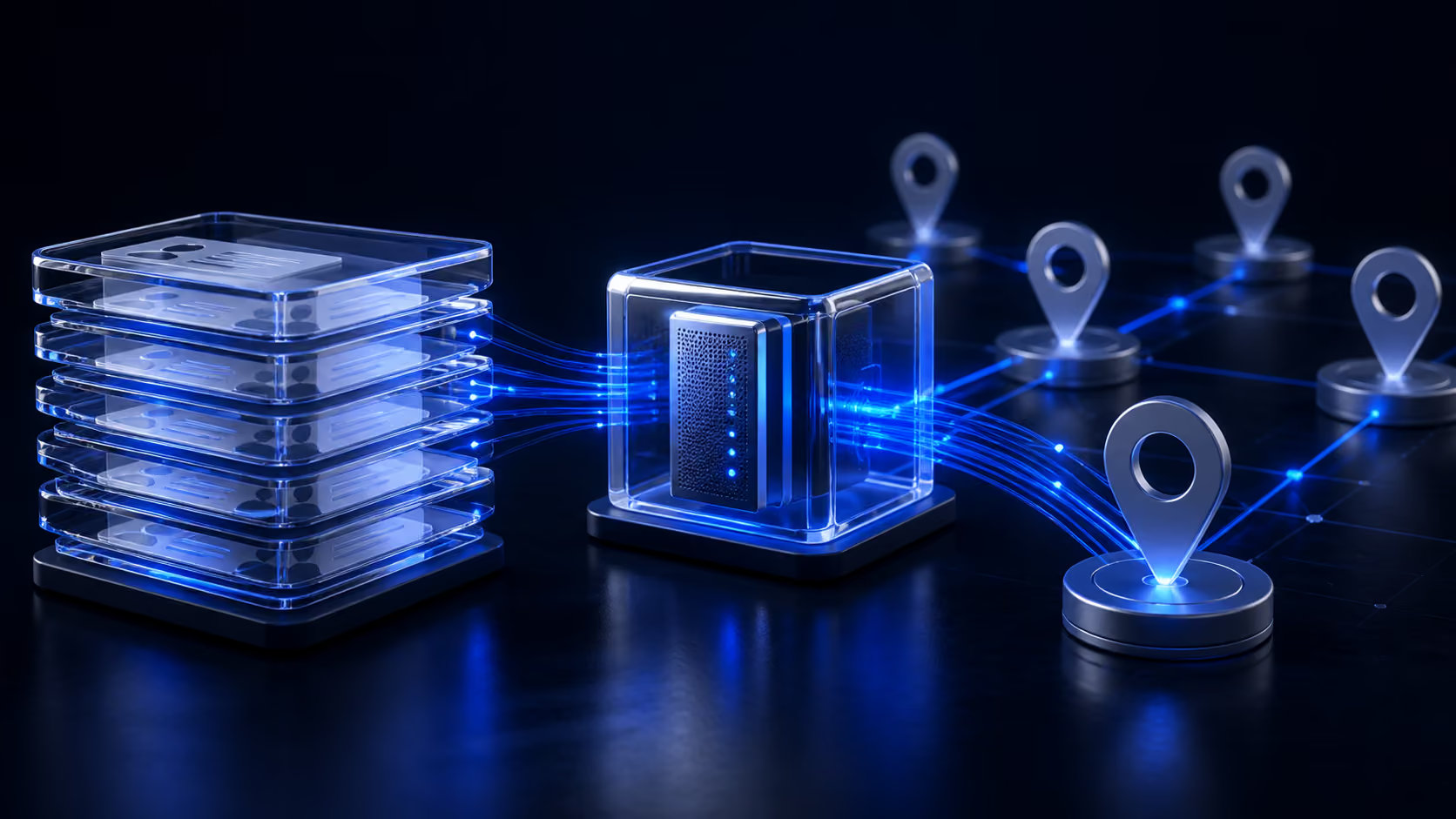
This is the most critical step. Instead of using a single server IP, you must route your requests through a network of real residential devices. With Magnetic Proxy, every time your script makes a request, it uses a new, authentic IP address. Because these IPs belong to real internet users, directories treat the traffic as legitimate human browsing, drastically reducing CAPTCHAs and outright bans.
Local directories serve different data based on the visitor's location. If you want to scrape businesses in Chicago, your request must appear to originate from Chicago. Using Magnetic Proxy’s free geo-targeting, you can append specific location codes to your requests (e.g., -cc-US-city-Chicago) to access accurate, localized search results.
Never scrape at a static, machine-like speed. Introduce randomized sleep intervals between your requests (e.g., waiting anywhere from 2 to 5 seconds) to mimic how a real human clicks through pages.
Keep exploring: See the Web Scraping Capsule for the relevant proxy setup, then read What Is a Residential Proxy? for the technical foundation.
Here is a practical example of how to configure a Python scraper using the requests library and Magnetic Proxy's rotating residential pool to safely extract data for your B2B lead generation pipeline.
import requests
import time
import random

# 1. Configure Magnetic Proxy with US Geo-Targeting
# Using the residential pool for maximum success rate (Avg. 99.95%)
proxy_user = "customer-USERNAME-cc-US"
proxy_pass = "YOUR_PASSWORD"
proxy_host = "rs.magneticproxy.net"
proxy_port = "443"

proxy_url = f"https://{proxy_user}:{proxy_pass}@{proxy_host}:{proxy_port}"
proxies = {
    "http": proxy_url,
    "https": proxy_url
}

# 2. Set realistic browser headers
headers = {
    "User-Agent": "Mozilla/5.0 (Windows NT 10.0; Win64; x64) AppleWebKit/537.36 (KHTML, like Gecko) Chrome/120.0.0.0 Safari/537.36",
    "Accept-Language": "en-US,en;q=0.9",
    "Accept": "text/html,application/xhtml+xml,application/xml;q=0.9,image/webp,*/*;q=0.8"
}

# 3. Target URL (Example Directory Page)
target_url = "https://example-directory.com/search?category=software&location=us"

try:
    # 4. Execute the request
    # Magnetic Proxy delivers an avg 0.6s response time
    response = requests.get(target_url, headers=headers, proxies=proxies, timeout=10)

    if response.status_code == 200:
        print("Success! Page accessed safely without bans.")
        # Proceed to parse the HTML using BeautifulSoup or lxml
        # html_content = response.text
    else:
        print(f"Failed with status code: {response.status_code}")

    # 5. Add a randomized delay before the next request
    time.sleep(random.uniform(2.5, 5.5))

except requests.exceptions.RequestException as e:
print(f"Connection error: {e}")Mastering web scraping is the ultimate leverage for any modern sales operation. By building your own data pipelines, you control the quality, accuracy, and volume of your prospects.
To ensure your infrastructure never fails, you need a proxy partner that delivers speed and reliability. Magnetic Proxy offers millions of rotating residential IPs, an average 99.95% success rate, and flexible Pay-as-you-go plans starting at just $5/GB.
Deploy your proxies on demand and start building your proprietary B2B prospect lists today.
Check the most Frequently Asked Questions
Why is web scraping critical for a modern B2B lead generation strategy?
Can my IP get banned while scraping local business directories?
What is the best proxy setup for safe B2B web scraping?
Is it legal to scrape public directories for B2B lead generation?
Here’s how Profile Peeker enables organizations to transform profile data into business opportunities.
Scale your scraping strategy with high-quality residential IPs ensuring stable connections, low latency, and cost-effective results.
Ask AI about Magnetic Proxy