



Scale your scraping strategy with high-quality residential IPs ensuring stable connections, low latency, and cost-effective results.
Ask AI about Magnetic Proxy





© 2026 Magnetic Proxy. All rights reserved.



Your competitor's entire content program is publicly accessible right now. Not behind a paywall, not locked inside a $400/month tool, not requiring a single API key. It's sitting in an XML sitemap file that every blog publishes automatically — listing every article they've ever written, the date they wrote it, and the last time they touched it.
Most content teams don't know this exists. The ones that do are making better strategic decisions than everyone paying for BuzzSumo.
This is a practical guide to competitor content strategy analysis using public web data: what to collect, how to collect it without getting blocked, and how to build a system that runs on its own. No SaaS subscription required to get started.
A systematic competitive content analysis tells you four things that no amount of SERP browsing reveals on its own:
In 2026, that picture is more valuable than it's ever been. Content strategy now requires auditing two search surfaces, not one: Google rewards backlinks and technical signals, while ChatGPT and Perplexity evaluate topical depth and credibility directly, with no link graph to lean on. A competitor's content program shapes their visibility on both surfaces simultaneously. If you're only tracking rankings, you're working with incomplete intelligence.
What is a competitor's XML sitemap?A competitor's XML sitemap is a publicly accessible file that lists every URL they've published, the date it was first indexed, and the date it was last modified — updated automatically as they publish new content.
You find it at predictable URL patterns: try /sitemap.xml, /sitemap_index.xml, or /blog-sitemap.xml on any competitor domain. Most CMS platforms generate and maintain it automatically. The file looks like this:
<!-- XML -- Competitor blog sitemap — lists every published URL with dates -->
<url>
  <loc>https://competitor.com/blog/article-title</loc>
  <lastmod>2026-03-14</lastmod>
  <changefreq>monthly</changefreq>
</url>
Each entry gives you the article URL, the publication date (from the first lastmod entry in your collection history), and the most recent modification date. Across a competitor with 200 blog posts, that's 200 data points you didn't have to visit 200 pages to collect.
What does a competitor's XML sitemap reveal about their content strategy?It reveals their complete publishing timeline: every topic they've covered, when they started covering it, how recently they've updated existing content, and which areas of their blog they're actively expanding. It's their editorial calendar, filed publicly.
A competitor's XML sitemap is the most underused source of content intelligence available. It lists every URL they've published, when they published it, and when they last updated it — in real time, without a login, without a SaaS subscription, and without scraping a single article page. It's their entire content program, filed publicly.
Collecting one competitor's sitemap takes seconds. Collecting 10 competitor sitemaps on a schedule, week after week, is a different problem.
Repeated automated requests to the same domain trigger rate-limiting within minutes — even for a simple XML file. The pattern is what gets flagged, not the volume. Ten requests from the same IP over 30 seconds looks like a bot. Ten requests from ten different residential IPs looks like ten different users. Tracking content velocity across multiple competitor sitemaps simultaneously requires the same residential proxy rotation that protects individual page crawls from rate-limiting blocks.
Tracking competitor content at scale across multiple domains requires rotating residential IPs. Without rotation, repeated requests to the same competitor blog trigger rate-limiting or IP blocks within minutes. Residential proxies distribute those requests across a pool of real home IPs, making systematic content monitoring indistinguishable from organic traffic to the target site.
Magnetic Proxy's residential rotating network achieves a 99.95% average success rate and 0.6-second average response time when collecting sitemap data across multiple competitor domains simultaneously — completing a full 10-domain content map in under 4 minutes with zero IP blocks. (Source: Magnetic Proxy, 2026)
If you're running collection across more than 3 or 4 competitor domains simultaneously, a residential proxy pool is the piece that keeps it from breaking. Magnetic Proxy starts at $19/month and connects in under 10 minutes.
⚠️ Important: Most rate-limiting blocks on competitor sites aren't triggered by the volume of requests — they're triggered by the pattern. Ten requests from the same IP in 30 seconds looks like a bot. Ten requests from ten different residential IPs in 30 seconds looks like ten different users. Residential proxy rotation is the difference between a collection run that completes and one that gets blocked on the third domain.
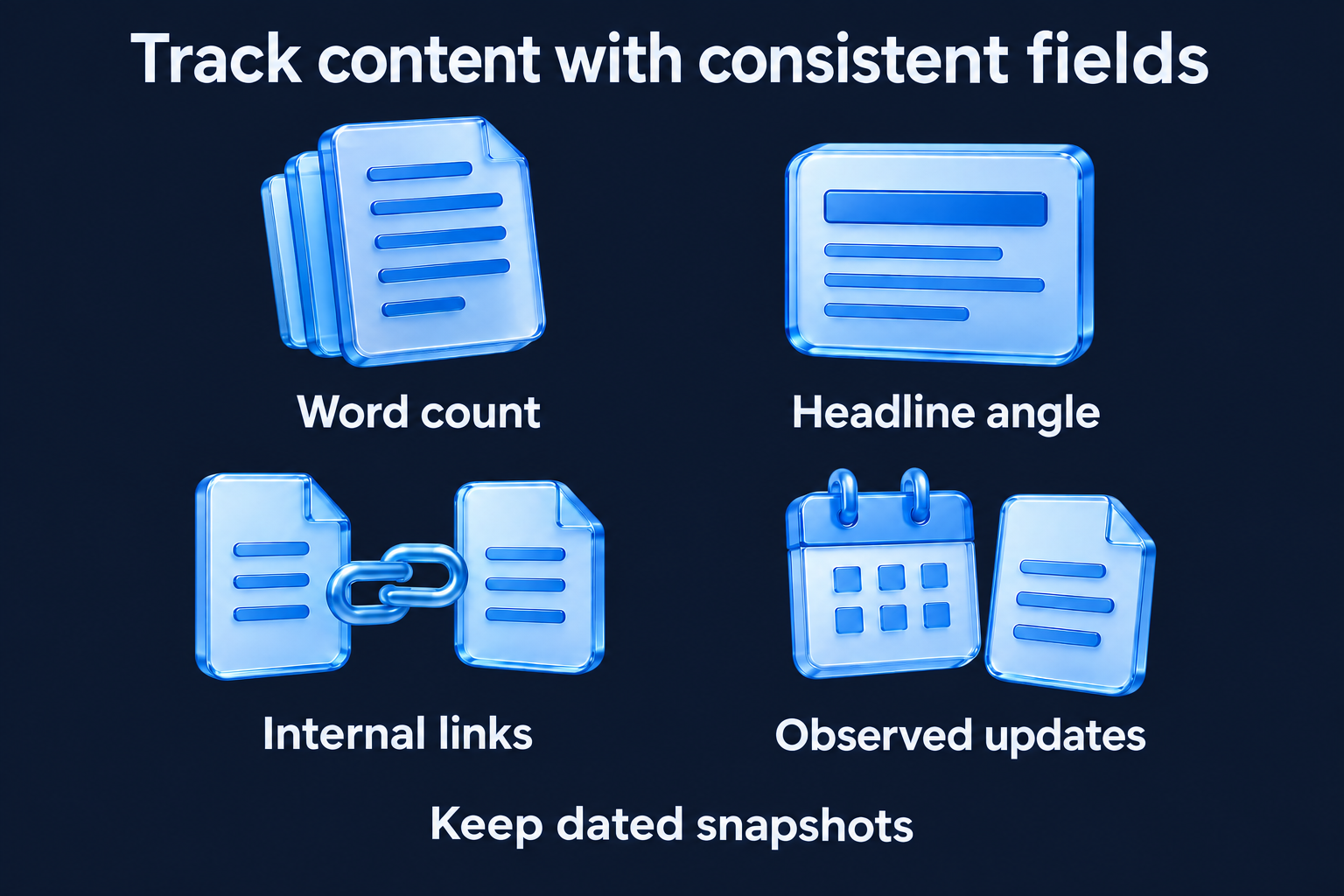
Collect four fields consistently: article word count, headline/H1 angle, internal links, and observed updates. Compare depth and framing, map links between pages, and retain dated snapshots. Treat sitemap lastmod as a signal to verify against the page, not proof of a substantive edit or a planned publishing cadence.
The sitemap gives you URLs and dates. The real competitor content strategy analysis starts when you pull signals from those URLs. Four data points worth collecting from each article:
1. Word count: Word count tells you the depth standard a competitor is setting for each topic. A competitor averaging 2,800 words per article on scraping tutorials is signaling that the bar for ranking in that cluster is long-form depth. A competitor averaging 900 words is betting on breadth over depth. Neither is inherently better — but knowing which bet they're making helps you decide whether to match it or outflank it.
2. Headline and H1 angle: When you and a competitor are both targeting the same keyword, the headline angle is where differentiation happens. Scraping their H1 tells you the framing they chose. If every competitor frames "web scraping proxies" as a security topic, and you frame it as an infrastructure topic, you're not competing directly — you're serving a differ
Keep exploring: See the Web Scraping Capsule for the relevant proxy setup, then read How to Build a Competitor Intelligence System for the technical foundation.
ent search intent with the same keyword target. That's a deliberate strategic choice, and you can only make it if you know what angle they're already occupying.
3. Internal linking patterns: The articles a competitor links to most frequently from other content are the articles they consider most authoritative. Collecting internal link data at scale across their blog reveals the pillar content they're building their topical authority around.
Strong competitors build tight topic clusters on purpose, linking related posts so crawlers move more easily, and mapping these clusters makes gaps easier to spot. (Source: SEOZilla, Competitor Content Analysis, 2026)
4. Update frequency: The gap between lastmod entries in your collected sitemap history tells you which content a competitor is actively maintaining versus content they've published and abandoned. Content they update every 60–90 days is content they believe is earning them traffic. Content they haven't touched in 18 months is content they've written off. Both categories are intelligence: the first tells you where they're investing, the second tells you where their coverage is going stale.
Competitor content strategy analysis using public web data surfaces four signals that SaaS tools aggregate and delay: publishing velocity, topical coverage, internal authority structure, and content maintenance patterns. Web scraping collects these signals directly from the source — in real time, at the granularity of a single article, without waiting for a tool's weekly data refresh cycle.
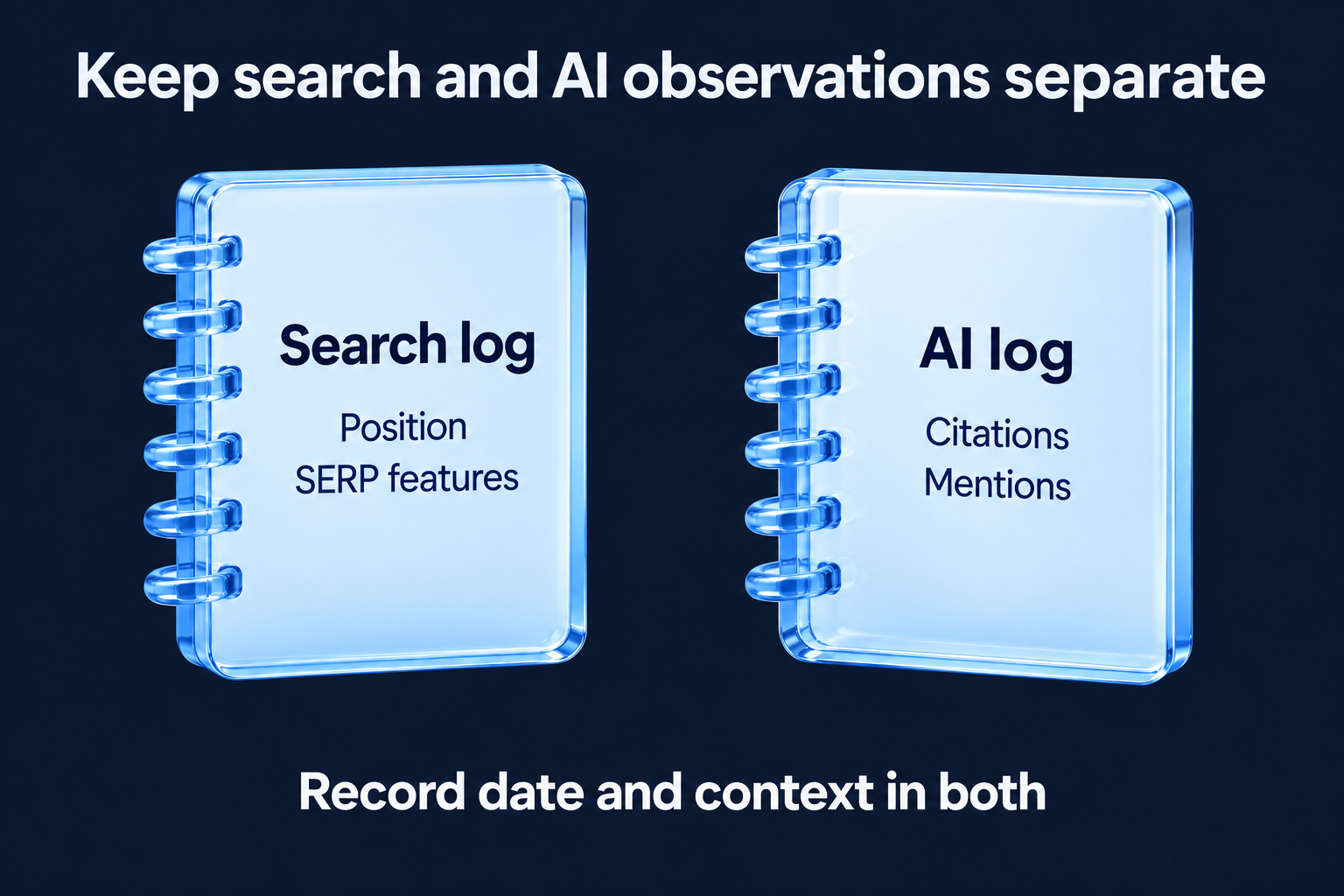
Keep two observation logs: search position and visible SERP features for a fixed query/location, and source citations or mentions for a fixed AI prompt. Record date and context for both. A mention, citation, ranking, and visit are different observations; do not combine them into one score or infer traffic from a screenshot.
Here's the scenario that changes how content teams think about competitive intelligence.
A content team noticed their competitor had dropped from position 2 to position 8 on a core keyword over six weeks. The signal looked clear: the competitor was losing ground. The team paused their own content production on that topic, assuming the competitive pressure was easing.
When they ran the same query on Perplexity, the competitor was cited in the first sentence of the AI answer. Their article wasn't losing — it was winning on a surface the team wasn't tracking. The competitor had deliberately shifted their content toward LLM citability: tighter definitions, verifiable statistics, structured Q&A pairs that AI engines extract cleanly. They traded Google clicks for AI engine authority. The team that only tracked rankings made the wrong strategic call based on half the data.
In 2026, tracking competitor content performance requires monitoring two independent surfaces. Google rankings reflect backlinks and technical signals. LLM citation frequency reflects topical depth and content authority. A competitor can lose Google traffic and gain Perplexity citations in the same quarter. A content intelligence system that only tracks one surface is missing half the picture.
On Google: SERP position for your shared highest-priority keywords, and featured snippet ownership. A competitor that owns the featured snippet for a keyword you're both targeting is capturing 30–40% of the available clicks before organic results appear. That's not a ranking gap — it's a structural gap.
On AI engines: Run your target queries on Perplexity and ChatGPT weekly. Log which sources get cited. A competitor that appears in AI answers for your core topics has built a citability signal you can't see in Ahrefs or Semrush. You have to run the queries manually.
Neither surface monitoring requires a tool. Both require a consistent process.
The goal is a system that runs on a schedule without requiring manual effort every time. Three components:
A simple Python script pulls the updated sitemap from each competitor domain once a week and compares it to the previous week's version. New URLs get logged with their publication date. Modified URLs get flagged for review. The output is a running record of everything your competitors have published and updated — accurate to the week, covering every competitor simultaneously.
#python
# Weekly competitor sitemap collector — logs new and modified URLs
import requests
import xml.etree.ElementTree as ET
from datetime import datetime

def collect_sitemap(domain, proxy_config):
    # Route through residential proxy to avoid rate-limiting blocks
    url = f"https://{domain}/sitemap.xml"
    response = requests.get(url, proxies=proxy_config, timeout=10)
    root = ET.fromstring(response.content)

    urls = []
    for url_elem in root.findall('.//{http://www.sitemaps.org/schemas/sitemap/0.9}url'):
        loc = url_elem.find('{http://www.sitemaps.org/schemas/sitemap/0.9}loc').text
        lastmod = url_elem.find('{http://www.sitemaps.org/schemas/sitemap/0.9}lastmod')
        lastmod_date = lastmod.text if lastmod is not None else None
        urls.append({'url': loc, 'lastmod': lastmod_date})

    return urls

# Configure residential proxy rotation for clean collection
proxy_config = {
    "http": "https://customer-youruser-cc-us:yourpassword@rs.magneticproxy.net:443",
    "https": "https://customer-youruser-cc-us:yourpassword@rs.magneticproxy.net:443"
}

# Output: list of URLs with lastmod dates — compare weekly to identify new and updated content
results = collect_sitemap("competitor.com", proxy_config)
The output is a timestamped list of URLs. Compare it weekly to identify everything new and everything updated. That's your competitor content calendar, built automatically.
Once a month, run a crawl of every new URL collected in the previous four weeks. Extract word count, H1, meta description, and internal link count from each page. Store the results in a spreadsheet. After three months, patterns emerge: which topic clusters they're expanding, what depth standard they're maintaining, and where their coverage is thinnest.
Magnetic Proxy's rotating residential proxies handle the collection layer — starting at $19/month with no setup required.
Every week, run your ten highest-priority keyword queries on both Google and Perplexity. Log the top 3 Google results and which sources Perplexity cites. Update a tracking sheet. After four weeks, you'll see which competitors are investing in LLM citability, which are defending Google rankings, and which are doing both. That's the strategic picture you're making decisions against.
For teams that want to extend this beyond content tracking into pricing, job postings, and product changes, building a full competitor intelligence system covers the complete data collection stack.
Competitor content strategy analysis doesn't require a SaaS subscription. It requires knowing where the data lives and having a system to collect it consistently.
The XML sitemap is the starting point — it maps everything your competitors have published and when. The signals you extract from each URL build the strategic picture. The two-surface audit completes it by showing you where their content is performing, not just what they've published.
Teams that build this system stop making content decisions based on what they happen to have noticed. They start making decisions from the same data their competitors are generating, collected directly from the source, updated every week. That's what competitor content strategy analysis built on public web data actually delivers.
See Magnetic Proxy's residential proxy plans and start your first collection run.
Check the most Frequently Asked Questions
How do you analyze a competitor's content strategy?
What tools do you need for competitive content analysis?
How do you track competitor content performance in 2026?
What is a content gap analysis?
How often should you run a competitor content analysis?
Here’s how Profile Peeker enables organizations to transform profile data into business opportunities.
Scale your scraping strategy with high-quality residential IPs ensuring stable connections, low latency, and cost-effective results.
Ask AI about Magnetic Proxy